Catholicgauze has found another gem of a map, this one a timelapse animation showing humanity’s expansion from Africa and on to world domination. There’s plenty of extra material on landmarks such as the Mt Toba eruption and various ice ages. Well worth checking out, but just be aware it will take a long time on a slow connection.
Category Archives: Asia
The logic train doesn't stop here
Nepal has fired a living goddess for the heinous, nigh unspeakable crime of visiting the United States.
You read that correctly.
Sajani Shakya is/was one of several kumari, a role held in high esteem by both Hindus and Buddhists. Kumari are chosen between the ages of two and four and stay in the role until they hit puberty. The main kumari is largely kept out of sight in a temple in Kathmandu, although Sajani was allowed to attend school and stay at home.
Although she wasn’t the top kumari, she was high enough in rank to mean she was barred from leaving the country. However, last month she went to several nations promoting a documentary about the living goddesses. Blogger and internet cool dude Andy Carvin met the gadget-loving Sajani during her trip — read about it here.
This AP report quotes officials as saying she was removed from her post for “breaking with tradition”. A task force is now seeking — yes, you also read THAT correctly — a new kumari.
How does one fire a goddess? Surely they are what they are, and no committee or government department can decide otherwise (although they do decide who the kumari is depending on tests and various criteria).
Nepalese teaching is that these girls are incarnations of the goddess Taleju, who supposedly leaves the child’s body when she has her first period or suffers serious injury/illness.
I claim no great understanding of Hindu or Buddhist teaching. But what has menstruation got to do with sanctity? Who decided the living goddesses are no longer goddesses after this point?
Heads in the sand
A group of 100 Japanese politicians have got together to say the Nanking Massacre never happened.
In 1937, the city (which is now more properly known as Nanjing) was subjected to a frenzy of violence by Japanese soldiers which has gone down in history as “the Rape of Nanking”. China says about 300,000 people were killed, although the most commonly-cited figure is between 150,000 and 200,000.
That’s not to say it happened all in one go. The city, which was capital of China at the time, fell to the Japanese army in December 1937 and the violence lasted about six weeks. Atrocities committed included rape, looting, arson and the execution of prisoners and civilians.
The members of Japan’s ruling Liberal Democratic Party say only 20,000 people were killed and there was “no violation of international law”.
Excuse me, but how do the extinguishing of 20,000 lives at the hands of an occupying army not count as a violation of international law? And how can this group seriously say the massacre was fabricated when they admit to 20,000 deaths?
And yet group member Toru Toida said: “We are absolutely positive that there was no massacre in Nanking.”
And I, my dear Toida, am absolutely positive you are talking complete bullshit.
The politicians base their claim on a study commissioned to coincide with the 70th anniversary of the incident.
While apparently referring to the Japanese government’s archives it seems to ignore years of historical research, the most successful of which is probably Iris Chang’s The Rape of Nanking: The Forgotten Holocaust of World War II.
There is also considerable graphic evidence of the various atrocities, some of which can be found on this Wikipedia entry (not for those of a sensitive nature).
The power of pork
Soaring pork prices are fueling Chinese inflation.
The cost is up 40% in the last year (while meat prices generally are up 26.5%), largely because of a blue-ear disease epidemic which has seen at least 18,000 pigs slaughtered. With pork a staple of the Chinese diet, and farmers no longer rearing the animals for fear of the illness, the shortages are having a knock-on effect.
Food prices in general are up about 8.3%, although consumer prices as a whole rose 3.4% in May. The government’s target is 3%, and so another interest rate hike is on the cards as the authorities try to cool an 11% annual economic growth rate.
And Reuters/Financial Times make an interesting observation:
Savers earn 3.06 percent on 12-month certificates of deposit, meaning that after a 20 percent tax is deducted, the value of their money is failing to keep pace with inflation.
This has encouraged millions of Chinese to cash in their deposits and punt on the stock market, which jangled government nerves by falling sharply last month after almost quadrupling in 2 years.
Communist in name only.
Inflation is a tricky bugger to quantify as different countries use different products in their calculations. For instance, Ireland is the only country that I know of in Europe which includes mortgage payments in its figures. This means the Irish inflation rate is above 5%, whereas if mortgage payments were stripped out it would be closer to 2.7% (the eurozone target is just under 2%).
Nonetheless, headline figures spook investors and jittery investors can instigate sell-offs that wipe billions off a stock market in just a few hours. It seems that, as with so much in life, confidence is everything.
Big Brother is watching…
The local government in Terengganu state, Malaysia, recently installed 16 CCTV cameras in a bid to improve security. However, they have a secondary use: spying on employees.
Surprisingly, state secretary Mokhtar Nong confirmed this to a local newspaper, saying the system would keep tabs on the 1,000 or so workers in the government’s administrative complex.
“We would know if they are adhering to office etiquette or playing truant, and we can also gauge if they are disciplined at work,” said Mokhtar, who will have access to the tapes.
There are plans to set up another 26 cameras in the near future.
What made me laugh about the story were the following passages, as scribed by Associated Press:
Officials and workers interviewed by the newspaper praised the measure.
State Communications Unit deputy director Ruslan Abdul Rahman was quoted as saying the decision was “a brilliant idea,” stressing that workers should “accept the move in a positive manner as this will actually encourage them to excel further.”
Abdul Mubin Ismail, who works in the youth and sports department, told The Star that the move was “not to pinpoint our errors but to mold us into becoming more responsible.” He added that the surveillance could also curb office politics and sexual harassment.
I wonder if these individuals are angling for promotion?
It’s all kicking off (follow-up)
Iraq has made a formal complaint over the Turkish bombardment of the Kurdish north.
The Turks have been shelling villages in Dohuk province and the city of Arbil, although the Turkish media reports the areas being targetted have largely been abandoned to Kurdish fighters.
In my last post on this topic, I noted how a cross-border incursion could have unpredictable and destabilising effects. It seems the Iraqi foreign ministry has come to the same conclusion. It has told the Turks that the artillery fire could “destabilise the region and could erode confidence between the two countries”.
The AP article linked to at the top of this post says the US has “opposed any unilateral action by Turkey for fear it would jeopardise the relative tranquility of northern Iraq”. However, I can not recall reading any such statement; at least not in recent times.
I am not an expert on this conflict, but I feel it has potentially widespread ramifications.
The Turks, in their eyes, have a legitimate security concern. The conflict with the Kurdish PKK has lead to tens of thousands of deaths over the last two decades. Turkey claims Iraqi Kurds are harbouring militants, who then slip over the frontier to launch attacks.
The Kurds also have legitimate grievances, such as cultural and political suppression. And we must always remain aware that the PKK is considered a terrorist group not just by Turkey, but by the US, NATO and EU. Their actions have caused the deaths and suffering of a great many civilians. They have been accused of grave human rights abuses.
Turkey fears an economically sound Kurdish region in Iraq — a territory that while not being independent outright would still possess great oil wealth — will lead to a major push among Turkish Kurds for union with their southern neighbours.
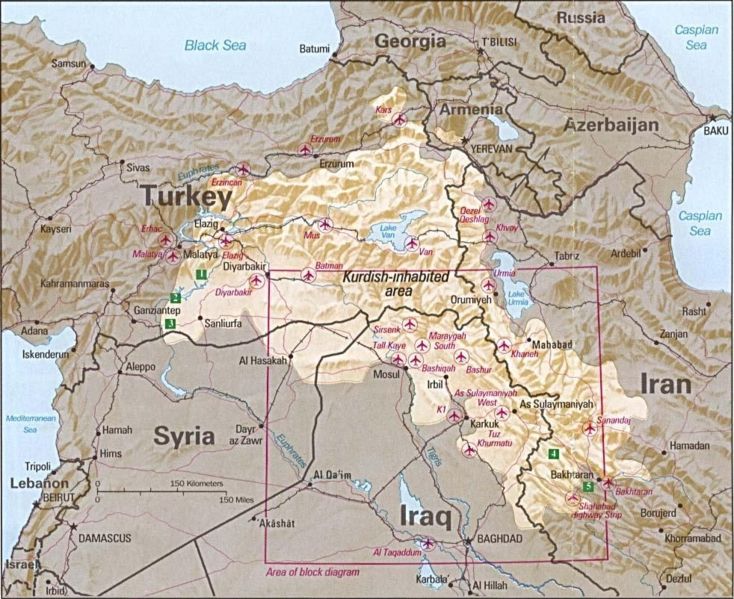
One might think that the Turks would welcome the departure of what it considers a restive ethnic group. However, the Kurds represent about 20% of the Turkish population and dwell in a broad swathe of territory in the nation’s southeast:
This is not a homogenous region. Many Turks live within what is generally referred to as Kurdistan (as do Arabs, Iranians, Armenians and many other groups). So the removal of this region from the political entity of Turkey would remove a great many Turks as well.
This would certainly be an economic blow. While there would be an accompanying reduction in spending on infrastructure, education, healthcare and the like, the sudden disappearance of 20 million people from the tax base would leave a major whole in government coffers.
But there are other factors, such as pride.
The Turkish government would not want to be seen as having abandoned many of its citizens to a new state (although there would always be the possibility of a population transfer, as was the case in India and Pakistan after their independence). Seldom are nations eager to give up national territory; historically human and state political ambition has always been more, more, more.
Security would be a further concern. Turkey would suddenly have a substantial, perhaps hostile nation on its southern and eastern borders. And Turkey does not formally recognise a Kurdish region within its state; this fluid situation would lead to further infighting over what would and would not be part of Kurdistan. It is possible that the Turks would view an independent Kurdish nation as a base for Kurdish rebels seeking to unify with Kurds still within Turkey.
There are solutions. A UN boundary commission is one, domestic referenda on a district-by-district basis is another. There are undoubtedly more which aren’t springing to mind right now.