Category Archives: Conflict

It’s all kicking off (follow-up)

Iraq has made a formal complaint over the Turkish bombardment of the Kurdish north.

The Turks have been shelling villages in Dohuk province and the city of Arbil, although the Turkish media reports the areas being targetted have largely been abandoned to Kurdish fighters.

In my last post on this topic, I noted how a cross-border incursion could have unpredictable and destabilising effects. It seems the Iraqi foreign ministry has come to the same conclusion. It has told the Turks that the artillery fire could “destabilise the region and could erode confidence between the two countries”.

The AP article linked to at the top of this post says the US has “opposed any unilateral action by Turkey for fear it would jeopardise the relative tranquility of northern Iraq”. However, I can not recall reading any such statement; at least not in recent times.

I am not an expert on this conflict, but I feel it has potentially widespread ramifications.

The Turks, in their eyes, have a legitimate security concern. The conflict with the Kurdish PKK has lead to tens of thousands of deaths over the last two decades. Turkey claims Iraqi Kurds are harbouring militants, who then slip over the frontier to launch attacks.

The Kurds also have legitimate grievances, such as cultural and political suppression. And we must always remain aware that the PKK is considered a terrorist group not just by Turkey, but by the US, NATO and EU. Their actions have caused the deaths and suffering of a great many civilians. They have been accused of grave human rights abuses.

Turkey fears an economically sound Kurdish region in Iraq — a territory that while not being independent outright would still possess great oil wealth — will lead to a major push among Turkish Kurds for union with their southern neighbours.

One might think that the Turks would welcome the departure of what it considers a restive ethnic group. However, the Kurds represent about 20% of the Turkish population and dwell in a broad swathe of territory in the nation’s southeast:
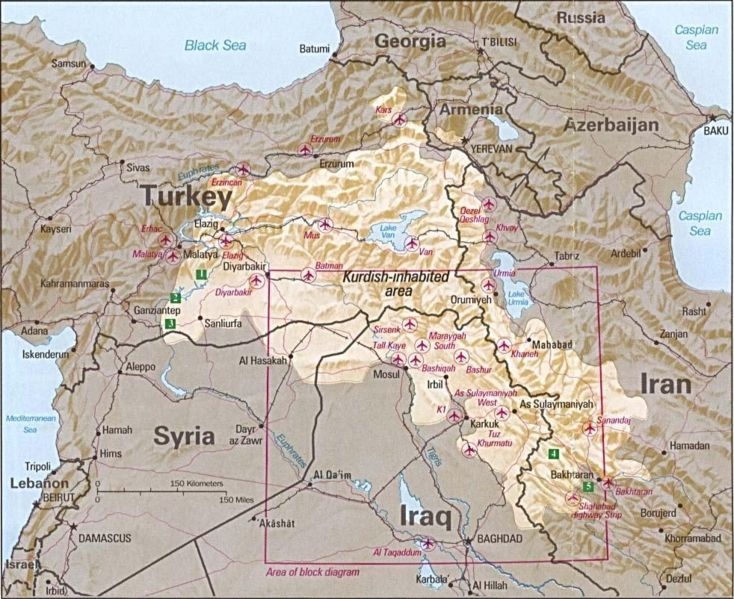
(from Wikipedia)

This is not a homogenous region. Many Turks live within what is generally referred to as Kurdistan (as do Arabs, Iranians, Armenians and many other groups). So the removal of this region from the political entity of Turkey would remove a great many Turks as well.

This would certainly be an economic blow. While there would be an accompanying reduction in spending on infrastructure, education, healthcare and the like, the sudden disappearance of 20 million people from the tax base would leave a major whole in government coffers.

But there are other factors, such as pride.

The Turkish government would not want to be seen as having abandoned many of its citizens to a new state (although there would always be the possibility of a population transfer, as was the case in India and Pakistan after their independence). Seldom are nations eager to give up national territory; historically human and state political ambition has always been more, more, more.

Security would be a further concern. Turkey would suddenly have a substantial, perhaps hostile nation on its southern and eastern borders. And Turkey does not formally recognise a Kurdish region within its state; this fluid situation would lead to further infighting over what would and would not be part of Kurdistan. It is possible that the Turks would view an independent Kurdish nation as a base for Kurdish rebels seeking to unify with Kurds still within Turkey.

There are solutions. A UN boundary commission is one, domestic referenda on a district-by-district basis is another. There are undoubtedly more which aren’t springing to mind right now.
It’s all kicking off

Turkish troops have entered Iraq in a move that can not be good for anyone.

No Turkish official is willing to put their name to the story confirming the operation, while the Foreign Minister has openly denied anything happened. But as Selcan Hacaoglu of the Associated Press notes, the nation’s authorities rarely acknowledge such activity.

Estimates of the number of troops ranges from thousands to several hundred — initial speculation put the figure at 50,000, which was the case in 1997 — but what runs consistent is that the military is pursuing Kurdish fighters.

It may only have been a couple of miles across the frontier, but it is troubling.

The military has for some time been pushing for a large-scale incursion to tackle the Kurdish separatists, the PKK, which Turkey considers terrorists. The Turkish army has been massing along the border in preparation; last week the country’s top general, Yasar Buyukanit, said his forces were awaiting government permission to cross into Iraq.

Turkey’s alliance with the US will grant it some degree of protection should it decide to step up its campaign against the PKK, which launches attacks from bases in Iraq. However, a full-scale incursion can only add to Iraq’s instability.

The introduction of this hostile actor in such a volatile stage will have unpredictable and uncontrollable results. The Kurds — who dwell in a stretch of territory that includes south-eastern Turkey and northern Iraq — will be squeezed into a corner. The Iraqi government will be in an intolerable position: if it allows a Turkish incursion its claim to govern its national territory will be null and void, while if it resists it faces provoking a conflict with its neighbour.

I am struck by the absence of international condemnation.

Imagine the outcry if the US was pushing for a military operation inside Canada, or China in Japan, or Britain in Ireland.

From stricken Darfur, a good news story

Every week Awatef Ahmed Isaac produces a newspaper documenting the life of Al-Fasher, capital of North Darfur. It’s handwritten and pinned to the same tree every time.

Awatef’s work is inspired by her late elder sister, who dreamed of publishing a newspaper for her town. Al-Raheel (The Journey) contains stories of the two million people who have been displaced by the Darfur conflict. But Awatef wants to build on her experience — her ambition is to produce a daily paper to campaign against poor public services and other such issues.

She came to international attention when The Washington Post ran an article about her earlier this year, but Mohamed Hasni of Agence France Presse has checked in with her. Since the Post’s article, she has been inundated with support and her journal is now available in English and Arabic at Sudaneseonline.com.

The political Gulf

The US and Iran have agreed a broad policy on Iraq.

The consensus, which must be reviewed in Washington and Tehran, calls for a “trilateral security mechanism” consisting of the three nations, and depends on the Iranians ending support for militants.

Iranian Foreign Minister Manouchehr Mottaki said the talks could lead to future meetings, but only if Washington admits its Middle East policy has been unsuccessful.

Iran and the US have been at odds for years, but things have intensified because of the Iranian nuclear programme. Adding to the tension were the recent American naval exercises in the Gulf, which has resulted in an increased US build-up in the region. However, the face-to-face talks between US ambassador Ryan Crocker and Iranian ambassador Hassan Kazemi Qomi — which focused solely on Iraq — do mark a slight thawing in relations.

It’s just too bad that people on both sides are looking for an armed conflict.

Steven Clemons reports that Dick Cheney is busy undermining diplomatic initiatives toward the Islamic Republic. It is a complex move on several fronts: elements within the Department of Defence and national intelligence are readying for conflict in a bid to convince Iran that it could be attacked, while Cheney and his cohorts want to persuade Bush that the military option is viable.

This runs contrary to the diplomatic efforts of Condi Rice, which are backed by the Pentagon, Director of National Intelligence Mike McConnell, Secretary of Defense Robert Gates and CIA Director Michael Hayden.

Apparently:

The thinking on Cheney’s team is to collude with Israel, nudging Israel at some key moment in the ongoing standoff between Iran’s nuclear activities and international frustration over this to mount a small-scale conventional strike against Natanz using cruise missiles (i.e., not ballistic missiles) .

This would provoke an Iranian military response and force Bush to abandon diplomacy in favour of another war.

Clemons has derived his information from a Cheney aide, who has been doing the rounds in Washington in a bid to drum up support for hawkish maneouvres against Iran. This official has apparently been saying words to the effect that:

Cheney believes that Bush can not be counted on to make the “right decision” when it comes to dealing with Iran and thus Cheney believes that he must tie the President’s hands.

A scary thought.

On the other side are Iranian President Mahmoud Ahmadinejad and the Revolutionary Guard. War would suit them down to the ground as it would give both a major boost in domestic support. Like the Cheney brigade, these actors are not necessarily advocating an out-and-out conflict, but manoeuvering so it becomes a viable, even preferential option.

Who would win such a conflict? That depends on the definition of victory. Ousting Ahmadinejad and implementing a more favourable regime (which would, quite incidentally, allow the US greater access to Iranian oil reserves) is one such definition. On the Iranian side, simply not being conquered would be enough. Repelling a US invasion — should it come to such a drastic measure — would be PR gold.

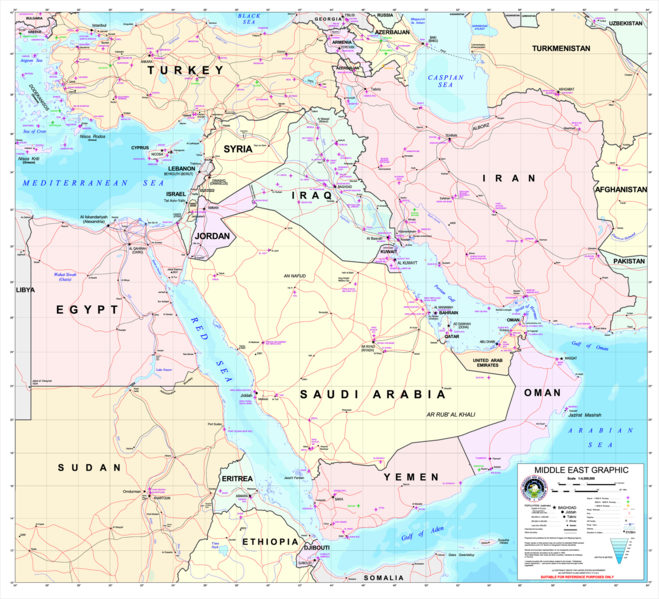
Anything the US has learned in Iraq would be practically useless in Iran. The US and its allies have had enough trouble subjucating Iraq, and Iran dwarfs its neighbour, as this Wikipedia map shows (click for larger view):

659px-middleeast.png

It is also a mountainous country, which would slow down any military advance and allow Iranian forces to conduct a successful guerilla war. It is unlikely the likes of Pakistan, Afghanistan or Turkey would allow the staging of an invasion.

But that said any war would most likely take the form (initially at least) of airstrikes on key infrastructure in a bid to bring the country to its economic knees. This was the pattern followed in Serbia during the Kosovan conflict and in Iraq prior to the invasion. It also offers the best PR strategy for the US, as its military can be seen as winning while risking very few of its members.

Both Cheney and Ahmadinejad are playing a dangerous game. A chaotic Iraq has already threatened to destabilise the region; a chaotic Iran would only add to this. Whether it would unlease further sectarian strife is a subject for wiser heads than mine. But there would be no happy ending to such a story.

Darfur

The UN has suffered its first casualty in Darfur since it began a small-scale deployment in December.

Lieutenant Colonel Ehab Nazir, an Egyptian national, was shot dead at his home. It appears to have been a burglary, but the world body hasn’t ruled out other motives. We shall have to wait and see if the investigation gets anywhere.

The news comes only a day after Sudan was presented with a proposal for a UN-African Union hybrid peacekeeping force. The 23,000-strong mission would be tasked with protecting civilians and helping to restore law and order.

There are already about 7,000 AU troops in the region, but these are supposed to be augmented by several thousand UN soldiers sometime this year. As it stands, the world body has less than 180 deployed there.

A peace deal was signed by the government and one rebel group in May 2006, but it has yet to be implemented. The fighting has continued between the Janjaweed militia and local militant forces.

There is the ever-present danger that the conflict will drag Chad and the Central African Republic — countries to where many refugees have fled — into the conflict, potentially starting a wider regional war (Chad and Sudan support each other’s rebels, although they recently signed a “reconciliation” deal).

The situation in Darfur only serves to make a further mockery of the United Nations. It passes resolutions which nations are free to ignore, and often can not provide adequate resources to achieve its stated objectives. It is hampered by politics and the risk of losing the donations of member states. As long as this situation persists the UN will never live up to its potential.

The hybrid force proposal will come to nothing. The UN Security Council won’t even pass a resolution until Sudan agrees to the mission, which it won’t as it considers it too big.

I have written before (in another format) on the defunct nature of the United Nations. I will try to dig up that particular essay and upload it. In the meantime, this is a good blog on how the media has become disengaged with Darfur.

Tragedy without end

The warring factions in Sri Lanka agreed a ceasefire five years ago. Officially, both the government and the Tamil Tigers say it’s still in place and they are observing the truce. In reality, the war rages anew.

About 65,000 people died during the war proper (1983-2002). More than 3,000 have died in the last year. About 160,000 have been forced to leave their homes. There have been allegations of human rights abuses and the killing of civilians by both sides. It seems the hopes raised by Norwegian-brokered peace talks five years ago have been dashed.

The conflict dates back to independence from Britain in the late 1940s. The new regime was Sinhalese-speaking and Buddhist in orientation, while the Tamils, who are largely Hindu with Christian and Muslim minorities, suffered widespread discrimination. War broke out when the Liberation Tigers of Tamil Eelam stepped up their low-level offensive into an armed campaign for a separate Tamil state on the island of Sri Lanka (incidentally, the vast majority of Tamils live in India).

The Tamil fight has stepped up dramatically in recent months. Having lost strategic territory to the military in September, the Tigers killed at least 130 government soldiers in one day of fighting (the number of Tamil casualties is disputed). They followed up the battle with a suicide attack on a naval convoy which killed about 100 soldiers. Bus bombings came next.

Then, in March, the rebels carried out their first airstrike. A second strike last week briefly knocked out the power to the island’s capital, Colombo. Previously, the Sri Lankan government had held total air superiority; the military continues to bomb rebel positions. The island’s only international airport is now closed at nights.

Despite the continuous artillery bombardment by the government, the Tamils operate a de facto state. There are Tamil laws, courts, police and even a forestry department. But they only continue to operate in the absence of government control of the north of the island, where the Tamil Tigers are strongest.

The stated goal of the Tigers — who are listed as a terrorist organisation by the EU and the US — is a Tamil state in the north and east of the island. The current Sri Lankan offensive has largely driven the rebel forces out of the east, which leaves the fortified northern heartland. There is no telling how bloody the fighting will be if and when the government launches a final assault to crush the rebels.

Matthew Rosenberg, who has covered the conflict extensively for the Associated Press, was given special permission to cross the frontier into rebel territory. You can read his report, which details how Tamil civilians are steeling themselves for war, here.