Category Archives: Current events

It’s all kicking off

Turkish troops have entered Iraq in a move that can not be good for anyone.

No Turkish official is willing to put their name to the story confirming the operation, while the Foreign Minister has openly denied anything happened. But as Selcan Hacaoglu of the Associated Press notes, the nation’s authorities rarely acknowledge such activity.

Estimates of the number of troops ranges from thousands to several hundred — initial speculation put the figure at 50,000, which was the case in 1997 — but what runs consistent is that the military is pursuing Kurdish fighters.

It may only have been a couple of miles across the frontier, but it is troubling.

The military has for some time been pushing for a large-scale incursion to tackle the Kurdish separatists, the PKK, which Turkey considers terrorists. The Turkish army has been massing along the border in preparation; last week the country’s top general, Yasar Buyukanit, said his forces were awaiting government permission to cross into Iraq.

Turkey’s alliance with the US will grant it some degree of protection should it decide to step up its campaign against the PKK, which launches attacks from bases in Iraq. However, a full-scale incursion can only add to Iraq’s instability.

The introduction of this hostile actor in such a volatile stage will have unpredictable and uncontrollable results. The Kurds — who dwell in a stretch of territory that includes south-eastern Turkey and northern Iraq — will be squeezed into a corner. The Iraqi government will be in an intolerable position: if it allows a Turkish incursion its claim to govern its national territory will be null and void, while if it resists it faces provoking a conflict with its neighbour.

I am struck by the absence of international condemnation.

Imagine the outcry if the US was pushing for a military operation inside Canada, or China in Japan, or Britain in Ireland.

Out and about

Egypt has freed a blogger who was detained more than a month ago for being a member of the banned Muslim Brotherhood.

Abdel Moneim Mahmoud, who is also a correspondent for British-based Arabic television channel al-Hewar, had not officially been charged. He had been detained along with 23 others, who were also set free.

Human rights group the El Nadim Center has claimed Mahmoud was taken into custody because of “the role he played in exposing crimes committed by the Ministry of the Interior through his blog, where he called for the release of detainees”.

The organisation also points out that Mahmoud took part in media activities arranged by Amnesty International after that group released a report documenting torture in Egyptian police stations.

The Muslim Brotherhood advocates an Islamic state — and let me state quite clearly that I support complete separation of clergy and state — but with democratic reforms Egypt needs.

For example, Egyptian presidents, with whom almost all power rests, have typically been elected in single-candidate votes since the country became a republic in the 1950s. September 2005 saw the first multi-party presidential vote; however, candidates were screened by an electoral commission which only allowed 10 of the 30 applicants to run. The Muslim Brotherhood, which has the broadest support of the opposition groups, had no candidate.

Unsurprisingly, Hosni Mubarack was re-elected.

A March 2007 referendum — which Amnesty International said represented the biggest erosion of human rights since 1981, when emergency laws were introduced following the assassination of Anwar Sadat — gave the president the power to dissolve parliament.

It also prohibited parties using religion as a basis of political activity, ended judicial supervision of elections and allowed for civilians to be tried by military courts in terrorism cases.

Isn’t politics fun?

The political Gulf

The US and Iran have agreed a broad policy on Iraq.

The consensus, which must be reviewed in Washington and Tehran, calls for a “trilateral security mechanism” consisting of the three nations, and depends on the Iranians ending support for militants.

Iranian Foreign Minister Manouchehr Mottaki said the talks could lead to future meetings, but only if Washington admits its Middle East policy has been unsuccessful.

Iran and the US have been at odds for years, but things have intensified because of the Iranian nuclear programme. Adding to the tension were the recent American naval exercises in the Gulf, which has resulted in an increased US build-up in the region. However, the face-to-face talks between US ambassador Ryan Crocker and Iranian ambassador Hassan Kazemi Qomi — which focused solely on Iraq — do mark a slight thawing in relations.

It’s just too bad that people on both sides are looking for an armed conflict.

Steven Clemons reports that Dick Cheney is busy undermining diplomatic initiatives toward the Islamic Republic. It is a complex move on several fronts: elements within the Department of Defence and national intelligence are readying for conflict in a bid to convince Iran that it could be attacked, while Cheney and his cohorts want to persuade Bush that the military option is viable.

This runs contrary to the diplomatic efforts of Condi Rice, which are backed by the Pentagon, Director of National Intelligence Mike McConnell, Secretary of Defense Robert Gates and CIA Director Michael Hayden.

Apparently:

The thinking on Cheney’s team is to collude with Israel, nudging Israel at some key moment in the ongoing standoff between Iran’s nuclear activities and international frustration over this to mount a small-scale conventional strike against Natanz using cruise missiles (i.e., not ballistic missiles) .

This would provoke an Iranian military response and force Bush to abandon diplomacy in favour of another war.

Clemons has derived his information from a Cheney aide, who has been doing the rounds in Washington in a bid to drum up support for hawkish maneouvres against Iran. This official has apparently been saying words to the effect that:

Cheney believes that Bush can not be counted on to make the “right decision” when it comes to dealing with Iran and thus Cheney believes that he must tie the President’s hands.

A scary thought.

On the other side are Iranian President Mahmoud Ahmadinejad and the Revolutionary Guard. War would suit them down to the ground as it would give both a major boost in domestic support. Like the Cheney brigade, these actors are not necessarily advocating an out-and-out conflict, but manoeuvering so it becomes a viable, even preferential option.

Who would win such a conflict? That depends on the definition of victory. Ousting Ahmadinejad and implementing a more favourable regime (which would, quite incidentally, allow the US greater access to Iranian oil reserves) is one such definition. On the Iranian side, simply not being conquered would be enough. Repelling a US invasion — should it come to such a drastic measure — would be PR gold.

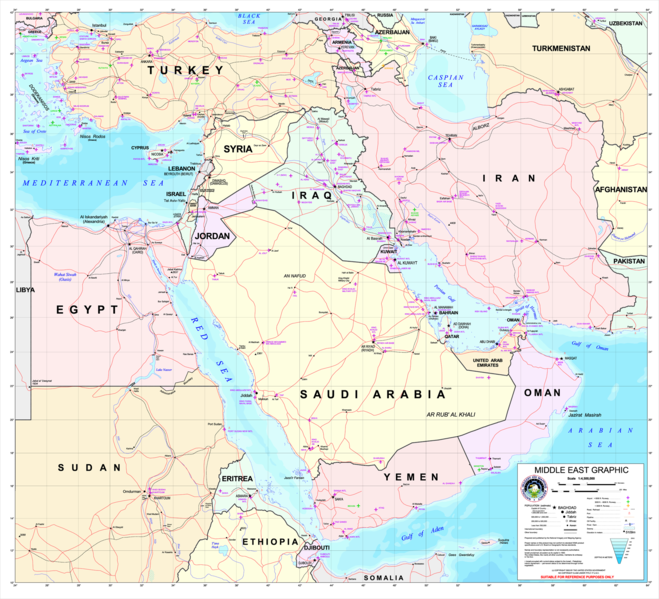
Anything the US has learned in Iraq would be practically useless in Iran. The US and its allies have had enough trouble subjucating Iraq, and Iran dwarfs its neighbour, as this Wikipedia map shows (click for larger view):

659px-middleeast.png

It is also a mountainous country, which would slow down any military advance and allow Iranian forces to conduct a successful guerilla war. It is unlikely the likes of Pakistan, Afghanistan or Turkey would allow the staging of an invasion.

But that said any war would most likely take the form (initially at least) of airstrikes on key infrastructure in a bid to bring the country to its economic knees. This was the pattern followed in Serbia during the Kosovan conflict and in Iraq prior to the invasion. It also offers the best PR strategy for the US, as its military can be seen as winning while risking very few of its members.

Both Cheney and Ahmadinejad are playing a dangerous game. A chaotic Iraq has already threatened to destabilise the region; a chaotic Iran would only add to this. Whether it would unlease further sectarian strife is a subject for wiser heads than mine. But there would be no happy ending to such a story.
Darfur

The UN has suffered its first casualty in Darfur since it began a small-scale deployment in December.

Lieutenant Colonel Ehab Nazir, an Egyptian national, was shot dead at his home. It appears to have been a burglary, but the world body hasn’t ruled out other motives. We shall have to wait and see if the investigation gets anywhere.

The news comes only a day after Sudan was presented with a proposal for a UN-African Union hybrid peacekeeping force. The 23,000-strong mission would be tasked with protecting civilians and helping to restore law and order.

There are already about 7,000 AU troops in the region, but these are supposed to be augmented by several thousand UN soldiers sometime this year. As it stands, the world body has less than 180 deployed there.

A peace deal was signed by the government and one rebel group in May 2006, but it has yet to be implemented. The fighting has continued between the Janjaweed militia and local militant forces.

There is the ever-present danger that the conflict will drag Chad and the Central African Republic — countries to where many refugees have fled — into the conflict, potentially starting a wider regional war (Chad and Sudan support each other’s rebels, although they recently signed a “reconciliation” deal).

The situation in Darfur only serves to make a further mockery of the United Nations. It passes resolutions which nations are free to ignore, and often can not provide adequate resources to achieve its stated objectives. It is hampered by politics and the risk of losing the donations of member states. As long as this situation persists the UN will never live up to its potential.

The hybrid force proposal will come to nothing. The UN Security Council won’t even pass a resolution until Sudan agrees to the mission, which it won’t as it considers it too big.

I have written before (in another format) on the defunct nature of the United Nations. I will try to dig up that particular essay and upload it. In the meantime, this is a good blog on how the media has become disengaged with Darfur.

Picture power

A seasoned sub-editor once told me: “If you’ve got a good pic, go big”. Here are a few newspapers that have designed their front page with a strong image in mind (click the thumbnails for a bigger view):

ny_amny.jpg

I love how the blue motif from the AM New York‘s masthead is continued in the background of the photograph and the strip ad along the bottom. The scale of the man inside the tunnel is great as well; and it’s one of those times when the headline practically writes itself.

bra_vale.jpg

Papa Benny is on tour in Brazil at the moment, bringing the love and talking theology. Here’s how the ValeParaibano in São José dos Campos marked the occasion. Although the pope is just sitting there, he still dominates the page. I also like how they’ve designed the page so Benedict is looking at the copy, which is about a Brazilian friar who has been canonised. I like the colour scheme too. The newspaper has picked out the gold from the pope’s outfit and used the colour for the headline and subhead at the bottom of the text; it’s nicely punctuated by the yellow/bronze headshot of the friar’s statue.

pol_dl.jpg

I have no idea what any of the stories are about on the cover of Dziennik Lódzki but I like the cut-out of the dancing couple. Interesting that they allowed it to cover the masthead, but good for them. It also works as a nice framing device and keeps the stories nice and tight.

uk_dt.jpg

Unsurprisingly, Tony Blair’s announcement he’s calling it quits as PM from June 27 made the front of most of the English papers. The Daily Telegraph has used a pic of the man himself greeting his adoring public in his constituency. It may not have been the strongest Blair photo of the day but it works well above the fold.

(All pics from newseum.com)

Tragedy without end

The warring factions in Sri Lanka agreed a ceasefire five years ago. Officially, both the government and the Tamil Tigers say it’s still in place and they are observing the truce. In reality, the war rages anew.

About 65,000 people died during the war proper (1983-2002). More than 3,000 have died in the last year. About 160,000 have been forced to leave their homes. There have been allegations of human rights abuses and the killing of civilians by both sides. It seems the hopes raised by Norwegian-brokered peace talks five years ago have been dashed.

The conflict dates back to independence from Britain in the late 1940s. The new regime was Sinhalese-speaking and Buddhist in orientation, while the Tamils, who are largely Hindu with Christian and Muslim minorities, suffered widespread discrimination. War broke out when the Liberation Tigers of Tamil Eelam stepped up their low-level offensive into an armed campaign for a separate Tamil state on the island of Sri Lanka (incidentally, the vast majority of Tamils live in India).

The Tamil fight has stepped up dramatically in recent months. Having lost strategic territory to the military in September, the Tigers killed at least 130 government soldiers in one day of fighting (the number of Tamil casualties is disputed). They followed up the battle with a suicide attack on a naval convoy which killed about 100 soldiers. Bus bombings came next.

Then, in March, the rebels carried out their first airstrike. A second strike last week briefly knocked out the power to the island’s capital, Colombo. Previously, the Sri Lankan government had held total air superiority; the military continues to bomb rebel positions. The island’s only international airport is now closed at nights.

Despite the continuous artillery bombardment by the government, the Tamils operate a de facto state. There are Tamil laws, courts, police and even a forestry department. But they only continue to operate in the absence of government control of the north of the island, where the Tamil Tigers are strongest.

The stated goal of the Tigers — who are listed as a terrorist organisation by the EU and the US — is a Tamil state in the north and east of the island. The current Sri Lankan offensive has largely driven the rebel forces out of the east, which leaves the fortified northern heartland. There is no telling how bloody the fighting will be if and when the government launches a final assault to crush the rebels.

Matthew Rosenberg, who has covered the conflict extensively for the Associated Press, was given special permission to cross the frontier into rebel territory. You can read his report, which details how Tamil civilians are steeling themselves for war, here.