Rodrigo Fonseca, editor of International Analyst, has been good enough to allow me contribute to his blog. My first article was a short one on the Hamas takeover of the Gaza Strip. Tis here.
International Analyst
Leave a Reply
I’ve just seen a news flash on Sky News that Israel says it considers Hamas-ruled Gaza a “terror entity” and the West Bank “an area of opportunity”. There are also reports of Israeli troops being sent to the Gaza-Egypt border.
This bodes not well. I have a horrible feeling we are looking at the prelude to an invasion of the Gaza Strip. I hope that is simply my brain drawing conclusions from quotes taken out of context.
Mahmoud Abbas has set up an emergency government, a move which should relax the Western embargo against the Palestinian Authority.
It comes as gunmen loyal to his Fatah movement capture Hamas bases in the West Bank.
This, in turn, is making a mockery of claims that the Palestinians will remain as one principality. Hamas says it does not intend to set up a state in Gaza, but that is the reality. Fatah’s offensive in the West Bank only consolidates the split.
The US is backing Abbas. This makes sense in the context of American foreign policy; the US is an ally of Israel and of the two main Palestinian groups Fatah is the only one which recognises Israel’s right to exist.
Hamas, on the other hand, wishes to destroy the nation.
The relaxation of sanctions could be an a major PR boost for Fatah and Abbas in particular. His party is largely responsible for its own downfall, but most Palestinians are willing to back whoever will get them food and the basic necessities. Thus, if Abbas is seen to have brought much-needed aid to his people his stock among them will rise.
However, he also exposes himself to claims of being a US puppet. This would be valuable propaganda from a Hamas perspective, but would not be of great significance among his citizens.
Gaza now seems fairly calm. But its future is uncertain; it is not a viable state by itself. The Gazan economy has been in freefall in the last six years, most of its industry is small-scale family operations and it depends on Israel for electricity.
An idealistic solution would be the disarmament of both Hamas and Fatah fighters by a strong international force under UN leadership. However, this is highly unlikely.
The political will just isn’t there for countries to send their troops to Palestine. The Gazans may only accept soldiers from Muslim nations, but this is a situation Israel would not tolerate.
This is not a scenario with an easy resolution on the horizon. Such a UN force would be stationed there for years; and given the difficulty the world body has had in forming a mission to Lebanon I can’t see it getting the numbers and resources it would need for a Gazan force.
Dialogue between the Palestinian groups is another possibility, although it may be some time for the situation to calm enough for this to take place. Even before the civil war numerous truces were called between the sides only to be broken hours later.
Do you think the crisis can be resolved?
The Palestinian civil war has put paid to hopes for a peaceful solution to the Middle East conflict.
The more moderate Fatah movement has been over-run in the Gaza Strip, with the Islamist Hamas taking key security posts all across the region. It has now captured Fatah headquarters in Gaza.
The image of the green Hamas flag flying above the building is possibly the most defining of the day.
All too late, Palestinian president Mahmoud Abbas has ordered his presidential guard to strike back. Yesterday, Fatah officials said there had been confusion: were they allowed to fight back or not?
Their resistance has crumbled; I have a feeling the claims of confusion were a desperate attempt to explain away just how easily Hamas has crushed its rivals.
“We are telling our people that the past era has ended and will not return, ” Islam Shahawan, a spokesman for Hamas’ militia, told Hamas radio. “The era of justice and Islamic rule have arrived.” (AP)
Given that Hamas is apparently executing Fatah policemen the definition of “justice” seems rather elastic, wouldn’t you say?
There is no hope for a negotiated solution between Hamas and Israel. Fatah’s decline, which began with an election drubbing fueled by a widespread perception of corruption and inefficiency, is complete (at least in the Gaza Strip).
The ambition had been for a two-state solution in the Middle East. The Palestinian state would consist of the Gaza Strip and the West Bank, both of which are fenced off from Israel.
The only viable way for such a split Palestinian state would be a highway crossing Israel; this was planned but there is no way Israel will allow militants such easy access to its territory.
And it must be pointed out that not all Palestinians back either Hamas or Fatah. One wrote to al-Jazeera earlier today: “Hamas and Fatah should go to hell and leave the Palestinian people alone.”
Hamas is unlikely to repeat its success in the larger and more populous West Bank, where Fatah is taking the initiative. I actually laughed when I read an AP report saying Abbas was considering withdrawing from the ruling coalition with Hamas. Strikes me as the first thing he should have done this morning.
The likelihood of an Israeli incursion into Gaza, which it evacuated in 2005, has soared. Hamas are not going to sit back on their Gazan victory, they will press an attack on Israel. It does not recognise the nation’s right to exist and has been firing rockets over the border for some time.
We now face the possibility of separate Hamas and Fatah states. EU humanitarian aid has been suspended. The UN can not distribute the aid which so many Palestinian people rely on. Egypt should be bracing itself for a flood of refugees and the formation of an Islamist nation on its northeastern border.
The dream of peace which was fostered by the 1993 Oslo Accords is shattered. All hope is lost.
US Undersecretary of State Nicholas Burns says Iran is sending weapons to the Taliban. It is the first time (to my knowledge) a senior American official has made such a claim.
The likes of Tony Blair have said “elements” within the Iranian regime were sending arms to Afghanistan, but this looks like a direct accusation against the government as a whole.
What really gets to me though is that the US is busy arming Sunni Arab groups to fight al-Qaida in Iraq.
“(Iran is) a country that’s trying to flex its muscles,” Burns said, “but in a way that’s injurious to the interests of just about everybody else in the world. I think it’s a major miscalculation.”
And how the US flexes its muscles is in everybody’s best interests? Arming militants to fight militants is a perfect calculation?
Iran has denied aiding the Taliban, saying it makes no sense for a Shi’ite regime to back a Sunni group.
With patience already frayed on both sides regarding Iran’s nuclear program, Burns’ comments are only adding fuel to the fire. Sometimes I wish politicians would just shut the fuck up.
Iraq has made a formal complaint over the Turkish bombardment of the Kurdish north.
The Turks have been shelling villages in Dohuk province and the city of Arbil, although the Turkish media reports the areas being targetted have largely been abandoned to Kurdish fighters.
In my last post on this topic, I noted how a cross-border incursion could have unpredictable and destabilising effects. It seems the Iraqi foreign ministry has come to the same conclusion. It has told the Turks that the artillery fire could “destabilise the region and could erode confidence between the two countries”.
The AP article linked to at the top of this post says the US has “opposed any unilateral action by Turkey for fear it would jeopardise the relative tranquility of northern Iraq”. However, I can not recall reading any such statement; at least not in recent times.
I am not an expert on this conflict, but I feel it has potentially widespread ramifications.
The Turks, in their eyes, have a legitimate security concern. The conflict with the Kurdish PKK has lead to tens of thousands of deaths over the last two decades. Turkey claims Iraqi Kurds are harbouring militants, who then slip over the frontier to launch attacks.
The Kurds also have legitimate grievances, such as cultural and political suppression. And we must always remain aware that the PKK is considered a terrorist group not just by Turkey, but by the US, NATO and EU. Their actions have caused the deaths and suffering of a great many civilians. They have been accused of grave human rights abuses.
Turkey fears an economically sound Kurdish region in Iraq — a territory that while not being independent outright would still possess great oil wealth — will lead to a major push among Turkish Kurds for union with their southern neighbours.
One might think that the Turks would welcome the departure of what it considers a restive ethnic group. However, the Kurds represent about 20% of the Turkish population and dwell in a broad swathe of territory in the nation’s southeast:
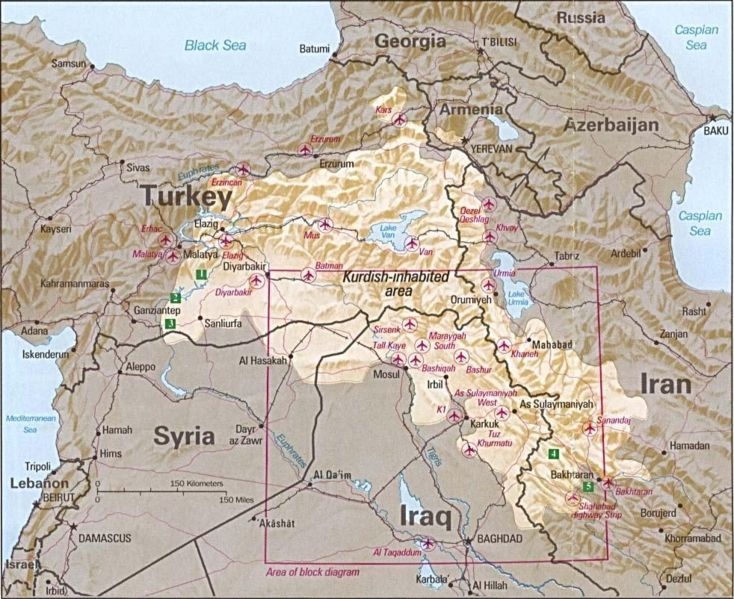 (from Wikipedia)
This is not a homogenous region. Many Turks live within what is generally referred to as Kurdistan (as do Arabs, Iranians, Armenians and many other groups). So the removal of this region from the political entity of Turkey would remove a great many Turks as well.
This would certainly be an economic blow. While there would be an accompanying reduction in spending on infrastructure, education, healthcare and the like, the sudden disappearance of 20 million people from the tax base would leave a major whole in government coffers.
But there are other factors, such as pride.
The Turkish government would not want to be seen as having abandoned many of its citizens to a new state (although there would always be the possibility of a population transfer, as was the case in India and Pakistan after their independence). Seldom are nations eager to give up national territory; historically human and state political ambition has always been more, more, more.
Security would be a further concern. Turkey would suddenly have a substantial, perhaps hostile nation on its southern and eastern borders. And Turkey does not formally recognise a Kurdish region within its state; this fluid situation would lead to further infighting over what would and would not be part of Kurdistan. It is possible that the Turks would view an independent Kurdish nation as a base for Kurdish rebels seeking to unify with Kurds still within Turkey.
There are solutions. A UN boundary commission is one, domestic referenda on a district-by-district basis is another. There are undoubtedly more which aren’t springing to mind right now.